New visitors please read this Blog from Old to New using Chronoblog, the past is important!

Tuesday, 18 March 2014

January 1990 Pt2.

What an exciting time it was, when the letter-box could be heard and that gentle thud of mail when it hits the carpeted floor in the morning (that's right the Royal mail delivered on time at 07:30!), especially when it was a thick A4 or A5 sized envelope!

What arrived was “The Rose” the Newsletter of Anime Hasshin number 19, was the 3rd. Anniversary issue (January 1990). This Bi-monthly Newsletter\magazine was the voice of the Anime club that had decided to be more mail-order oriented, to quote the founder Lorraine Savage “We're a family of Anime fans sharing what we love.”, and what you got was news on Manga and Anime in the U.S.A. & Canada and some translated news from Japan too.
With what was to become an average page count of 20 pages, this bumper issue had 24 pages of hand-typed two column style though-out the issue, and lots of “Black & White” artwork by fans that complimented the 'Editorial', Anime reviews, manga reviews, OVA reviews, mini synopses, and Japanese vocabulary lessons, and other Special features were all done in a strong Black ink
Information on other Clubs, Fanzines, Computer Bulletin Boards, APAs, Classifieds Adds, Conventions, Businesses, and a Members list, made such a ravenous read that you could not wait the 6 to 8 weeks for the next News Letter to come.

There was a Review on the popular TV show 'Kamagure Orange Road', a Manga review on Leiji Matsumoto's story telling and art style, as well as an OVA review on 'Cosmo Police Justy'. I also found the two page over-view of the 1966 TV show 'Prince Planet' very informative, and the Recommended Anime by Lynn & Lorraine Savage spot-lighted 'Super Gal' by Rumiko Takahashi, 'Famous Detective Holmes' by Hayao Miyazaki, and 'Sherlock Hound' the English version (in 2010 the chain of British high street stores 'HMV' released an exclusive DVD box set, that I gladly picked-up).

Many like myself would scrutinised all the information we could glean from each issue, and start an investigation and write off for answers on our own.

[Note: At the time of publication (January 1990) Anime Hasshin had 177 members Worldwide, three of whom were from England: Jay Felton, Mr. Horseman; Mr. Willett.]

[Note: This Anniversary issue had all 177 members printed, 95% had full details so you could contact them via post – it was a family of Pen-Pals.]

[Note: A synopsis is a brief summary or a condensed statement of the major points of a subject (be it Anime or Manga in our case) giving a general overall view, without opinion or review.]

Wednesday, 19 February 2014

January 1990 Pt1.

Moving forward in to the 90's with the knowledge of a Video programme that would be a part of the British Science Fiction Convention (EastCon 90) taking place over the weekend of the 14th. of April, and the hopes of meeting like-minded people for the first time, gave me the motivation to find more information and make new contacts regarding Japanese popular culture.

[Note: In Post 6. I touched upon the importance of the British FanZine MekTek.

The art of polite letter writing, whether a letter was handwritten or typed (on a manual typewriter no less!) people did embellish the envelopes, make their own letter-headed paper, and had little pieces of artwork to accompany their signature, this all added to the Pen-Pals network a sense of community however far apart we all where. Having the patience for a reply (that would take weeks in some cases, as International mail can take its time), add to this that you may not be the only person writing to them that week, the time scale for communicating back and fourth was unlike today’s electronic mail and messaging services for speed of delivery!

[Note: In Post 25. I start to hint at the importance of the September (1989) issue of Appleseed Book 3 part 2, as the gateway to the American Anime Fandom, and a means to contact Pen-Pals in the Uk. American Anime Fandom, started to find more details here EDC & Anime Hasshin.]


So the the two main American Anime Fan clubs I contacted where 'Anime Hasshin' and the E.D.C., and may I add that I was not the only one who had seen the listings in the issue of the Appleseed Comic-book, and that many American Fan clubs had contacts and members lists to put people in touch with one another, that was all part of the family of the Anime Fandom in those days. As you can see from these flyer’s Anime characters, Science Fiction and Comedies where popular icons of the day!

 I hope you can name all the Anime characters?!


Saturday, 15 February 2014

Goodbye 1980's

As an afterword to the 80's I feel I must add to the UK's Anime & Manga history a few words on the Robot invasion to our shores from FASA Corporation's franchise “BattleTech” its gritty interpretation of the fare future, in which the Succession Wars are set in the 31st century several hundred years after the fall of the Star League when humanity had colonised the stars, now feudal lords continuously war for more territory across the stars, planet by planet. It's not a shiny future as most, if not all of the manufacturing technology and know-how has been destroyed by conflict, this thoughtfully fleshed-out universe could easily be compared to the political back-drop from frank herbert's Dune.

What makes this far flung future so engrossing is the men and women who pilot the war machines used in these conflicts, called Mechs, the constant repair, and decay, the scavenging for parts, even the danger of the machine over heating and shutting-down was as much a risk of battle than the enemy! These Mechs bipedal 30ft to 50ft. Tall human-like war machines were categorised as; Light; Medium; Heavy; Assault, and LAMs and organised in to a Lance, a squad of 4 Mechs to suit the theatre of battle and there mission objectives.

BATTLEFORCE (back of BOX art).

BATTLEFORCE Rule book.

CITYTECH (Front BOX art).


[Note: I had a copy of the 'Technical Readout: 3025' published in 1986\1987, it had 55 'Mechs, 15 aerospace fighters, 3 LAMs, 4 DropShips and 12 combat vehicles, and all background details for the BattleTech universe, and their properties in the game.]

[Note: What the 'Technical Readout: 3025' showed was original Mechanical Designs faithfully copied from Japanese Anime TV shows (but no details given of their origins) "Fang of the Sun Dougram" from Sunrise Studios, and Studio Nue's "Crusher Joe" & "Super Dimension Fortress Macross". These designs stood out far beyond the home-grown American Mechs designs, and in many cases had been seen as model kits either imported original kits or re-badged kits by Revell.]

Now BattleTech also re-badged these robot model kits, it was a great time for Science Fiction model making hobbyists, and another opportunity to find out more about the Japanese cartoon shows, leading to Amine & Manga!

[Note: BattleTech\FASA Corporation had unbeknown to us at the time, had a few licensing legal issues with other American companies, most notably 'Harmony Gold' who thought that it owned the Intellectual Property of “Macross” and any of its images and thus merchandise! Hence BattleTech of the late 80's & early 90's is referred 'Classic BattleTech', and many Mech designs are now known as the "unseen!"]


I will leave you the reader to explore and search for knowledge on "Crusher Joe", "Super Dimension Fortress Macross" & "Fang of the Sun Dougram", enjoy. 
[you do have the Internet and its search-engines NOW!]

Tuesday, 4 February 2014

Robotech Pt. 2


Robotech comic-books and novels gave us (in the UK); a grasp of the plots of this Science Fiction series called Robotech, that was like nothing else we had come across to this side of the pond.

Comico's 'Robotech - The Macross saga' (Issues 1 - 36).

 'Robotech - Masters' (Issues 1 - 24).


ROBOTECH SPECIAL MAY-1988
(Dana's Story - An ending...And a beginning..of the amazing odyssey of ROBOTECH.)


'Robotech - The New Generation' (Issues 1 - 25).

The flood of these helped maximized the impact, with the simultaneous release of Comico's 'Robotech - The Macross saga' (Issues 1 - 36), 'Robotech - Masters' (Issues 1 - 24), and 'Robotech - The New Generation' (Issues 1 - 25), and add to this the Robotech Novels by “Jack McKinney” from Del Rey Books coming out every month for the first year, to a total of 21 novels, as well as Matchbox Toys. 

The American company 'Harmony Gold' was getting very well known!


[Note: Del Rey Books' Publishers note states that “While the above biogrophy is accurate, it is actually a composite bio of two authors who agreed to merge minds and identities to become Jack McKinney, and reflects the influence of various friends and advisors for the Robotech series.”]


To my knowledge only 3 separate VHS (Pal) video tapes were ever released in the UK in the 1980's showing episodes from the 'Robotech' series; “Codename Robotech” (a promotional compilation of episodes – some looped), Robotech episodes 1 & 2 (this Little Gem, had the wrong graphic on its front cover!), and 'Robotech II the Sentinels' (an all new storyline from Carl Macek & Harmony Gold Animated in Japan, cancelled after only 3 episodes – then edited into a movie). 


[Side note: the Robotech Art 1 (1986); has 25 pages devoted to Robotech's roots in Japanese Anime from the 1950's to the mid 1980's, a 2 page introduction on “Harmony Gold” (the American production company) as well another 2 pages listing the staff and their job tiles who work for “Harmony Gold”, and the a comprehensive list of name changes from the Japanese Anime to the American Robotech TV show ( I was able to provide these name changes to Helen McCarthy for an early article she would write on Robotech) – And you will be surprised to know about the days before and after the “Carl F. Macek Gallery” (1982) which sold pencil art & original cels & film posters of animation from around the World.]


There were also detailed Robotech Role-Playing game books and promotional gazettes published by Palladium books that had started to be imported by the late 80's given Mecha fans.
Palladium books also distributed Robotech episodes on VHS (NTSC) tapes in the US & Canada.

The Canadian Official Robotech Fanzine 'Protoculture Addicts' was the first of the irregular publications to hit our shores in the UK, that centred on this much beloved TV show and also hinted at a much wider world of animation that did not dumb-down to its young audience, referred to as Japanimation.

[Note: I have tried to convey the impact to the UK in the 1980's, so I've not lingered on details, and leave it up to you the reader to search for more information.]

In the 1980's without Macross there would be no Robotech, and without Robotech and its Fandoms in Canada and in the USA peeking our curiosity for giant robots and providing us with the springboard to look in to its Japanese origins and other Anime, the UK Anime Fandom would have surely stalled!

Robotech should no longer be thought of as “frankenstein's monster” but a doorway to Anime from a simpler time that reached so many!


Monday, 3 February 2014

Robotech Pt. 1

The late 80's was for a few of us the very start of pen-pals becoming a UK Anime Fandom, with the help of many different American animation fan-clubs. 

With so little in the way of cartoon series on our meager 4 terrestrial Television channels (and Satellite TV was out of reach of so many); that SF Geeks could follow, even such shows as 'Battle of the Planets' and 'G-Force', 'Ulysses 31' (that later would be know as Anime) were episodic in nature, story arcs, sub-plots, and character development were practically non-existent for what was essentially a kids TV cartoon shows.

[NOTE: ROBOTECH was shown on a cable & satellite TV channel called 'Premiere' in 1986 onwards (also known as 'Mirrorvision' from 1985) in the England, at 4.30pm to 5.45pm. (the after school slot). You can find a link to the 1986 'Premiere' channel preview at http://www2.tv-ark.org.uk/otherchannels/premiere.html .]

[NOTE: 'Premiere' was the original pioneer in broadcasting subscription premium movies, and to view the channel via satellite you would have needed some expensive equipment and a satellite dish of around 1.5 metres in size! It's largest audience was via Cable TV. ( I have yet to fine the full extent of its broadcast subscription area) -]

[NOTE: Alan Russell Wrote on the 22nd of March 1990 telling me that “ Premiere HAVE SCREED BOTH 'The Macross Saga' and 'Masters', but not 'New Generation' which as far as I know is unshown over here.” & “ROBOTECH itself does have of course have quite a following in the UK and has been shown on Satellite and Cable courtesy of 'Premiere' and the Super channel”. This may have been more to the south of England as I had not heard or see it in the Midlands in the 80's, or early 90s. - The Premiere channel shut down in July 1989).   Other Cable & satellite channels such as the 'Super Channel' launched its opening night on January 30th 1987 (the station was taken over by American broadcaster NBC in 1993) that I've been told that it to showed ROBOTECH. - but I can not find any more information at this time.]


The 'Robotech' franchise with all its merchandise had gradually filtered down to the UK, to its hobby shops and comic-book outlets, and toy shops with it came one of our main sources of information on Anime. Little by little we learned about how the Japanese animated TV series 'Super dimensional fortress Macross' was reborn and remoulded as the first saga of a generational story arc for an American audience under the title Robotech.

[NOTE: The irrational dislike or hatred of spiders and snakes is at some point a learnt response, so In that vein I will add 'Robotech' & the man most closely associated with it 'Carl Macek' be given a fair hearing and for you the reader an open mind. From my own point of view the Anime series 'Macross', that inspired the start of an American cartoon franchise 'Robotech', that still fuels the debate to this day, on how to edit and dub Japanese animation for a mainstream Western\English speaking audience, more so than the Dub Vs Sub debate.]

[NOTE: I will centre on the first Robotech saga 'Macross' as it was the least altered from its Anime counterpart.]

'Super dimensional fortress Macross' aired in Japan in 1982 and ran for 36 episodes was the brainchild of Shoji Kawamori together with the talents of Kazutaka Miyatake and Shoji Kawamori from of Studio Nue designing the iconic Mecha, and character designs by Haruhiko Mikimoto from the Artland animation studio.

What made this kids cartoon stand out was its storytelling that took you along in seeing the characters grow with their relationships with one another in dealing with the situations thrust upon them in a realistic manner. The troubles and emotions of a love triangle, the struggle of civilian and military points of view in the face of conflict, friendship born of battle, and the loss of a comrade, and women’s careers (military & that of an Idol singer) taking their toll on relationships, all taking place against the backdrop of the first Human-Alien war, and the constant threat of the next battle just around the corner. Coupled with this, the action of futuristic battles featuring the recognisable Mecha (from the model kits boom in the 80's) and space battles the like of which had not been seen since Star Wars. The Robotech 'Macross saga' would gain a growing and loyal fan-base for these reasons. 

[NOTE: Very little was edited in the way of story arc from Macross, but the other two cartoon shows Super Dimension Cavalry Southern Cross ( The Masters) & Genesis Climber Mospeada (The New Generation) were somewhat altered to tie-in the story arc (they were added to meet demands of American television minimum syndication needs of 65 episodes. Robotech's 85 episodes was originally aired in North America in1985).] 


Monday, 27 January 2014

Fledgeling Comic Books Pt. 26

In the US Americanised Anime had, had some success on the television networks, and had spawned a few comic books paying tribute in the likes of - Speed Racer, The Original Astro Boy 12, Leiji Matsumoto's Captain Harlock, and Star Blazers (and to this day, generations fondly remember the TV shows, including the edited and Americanised Robotech series).

The primordial imported comic-books of translated manga from the US in the late 80's were instantly recognised by their name when they became an Anime. 

[UPDATE: The first Manga to be taken from an existing Cinematic Intellectual Property was based on the Toho Company's film; Gojira 1984 (English Release “Godzilla 1985”), and not a published Manga first.]


Gojira the manga was first published in Japan by; Shogakukan, Inc. and with story and art by Kazuhisa Iwata. This IP was licensed to Dark Horse Comics in 1987, and was advertised to be published and printed for April 1988, as a Six Issue 'Black and White' comic-book Mini-series.


After looking into the history of Godzilla comic-books published by Dark Horse, only this manga was ever translated into English, the other stories, of Godzilla were written by Dark Horse's American staff, but oddly enough this first Manga for Dark Horse did have a Trade Paperback\Graphic Novel that had three printings (1st. Printing January 1990, 2nd May 1995, 3rd May 1995.), there was also a Re-Printing (and renaming) of the mini-series in 1998, in colour - no less!; “DARK HORSE CLASSICS TERROR OF GODZILLA” . The Fourth printing was in the British Anthology comic-book magazine 'Manga Mania' published by Dark Horse International in 1993.
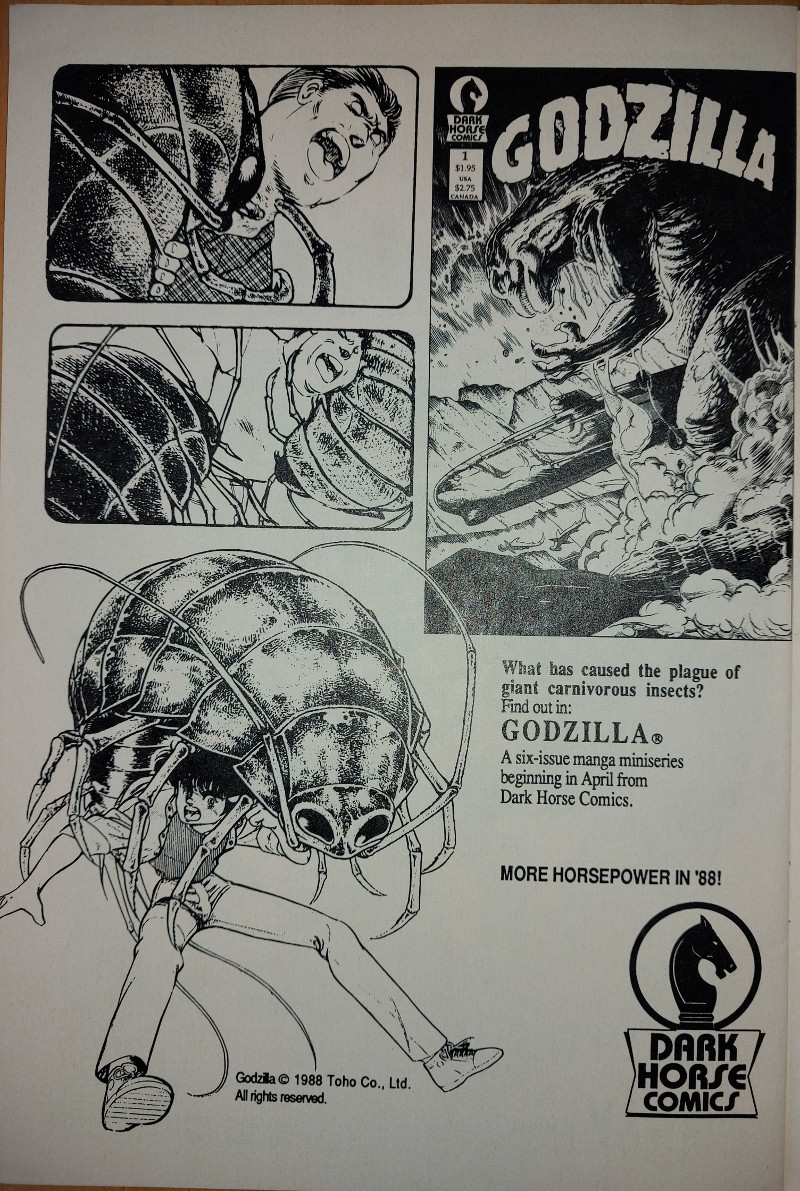

'GODZILLA'


Godzilla #5 (December 1988) & Terror of Godzilla #5 (December 1998).

Godzilla #5 (December 1988) & Terror of Godzilla #5 (December 1998).


CLODZILLA (  )

CLODZILLA (  )


CLODZILLA (  )


These heavily influenced the UK Fandom (go with what you know), and when so few of us could translate Japanese, and have access to Sub-titling equipment the comic-books provided the familiar stories and plots, so that you could enjoy the Anime even more.

LONE WOLF and CUB.

MAZINGER.

AKIRA.

Some of these comic-books would stand the test of time (still selling enough for reprints every few years or so) Nausicaä of the Valley of the Wind, AKIRA, Lone Wolf and Cub as their Copy-rights changed hands, or the licence holder was bought-out by a bigger producer or Publisher!

What early UK Anime Fan would not have in their collection of OVAs, TV episodes and films of :- Baoh, Dirty Pair, Nausicaä of the Valley of the Wind, AKIRA, Crying Freeman, Appleseed, Kamui (Dagger of), Outlanders, Grey (Digital target), Fire Tripper, Dominion (Tank Police), Lum, Justy (Cosmo Police), Fist of the North Star, and Area 88.

[Note: By the arrival of the mid 90's the Japanese manga style, and its genres where being imitated by Western cartoonist and comic-book artists.]


This comic-book influence would continue in to the 90's as more fans gravitated towards Manga for its more mature reader. The sensationalistic violence (sometimes graphically depicted on the side of gratuitous), and horrific portrayals of cause and effect, as well as semi nudity may have enticed many, but good storytelling with protagonists that you had infested in emotionally sold well.
Just looking at the artwork of a still of an animated cel, you began to recognise the Artist and the Animation Studio and then you are well and truly hooked!

[Note: comic-books where a jumping off point for sources of information on Japanese pop culture, as mini articles by the Editors, Translators, and the Writers themselves would sporadically appear. Even the humble 'Letters page' would give us some insight in appreciating this new wave of comic-books, and after all many a Fan Club & Pen Pals was the catalyst that unite us.]

Wednesday, 1 January 2014

Lost Manga from the 80's Pt. 25


Baoh. Written and illustrated by Hirohiko Araki. Viz Comics, published in a monthly format for a total of #1 - 8 issues, from December 1989 to July 1990, English adaptation by Fred Burke & Wayne Truman. Originally published and serialised in Shueisha's Weekly Youth Comic Magazine “Shōnen Jump” from 1984 to 1985. 

Doress is a secret and most sinister organisation’s company laboratory are in the process of bio-engineering a new lifeform not unlike a parasitic worm or leach code named 'Baoh', that protects its host from hostilities as the threat levels increase so does its countermeasures (this I would think would haveMilitary applications, well for those who could afford it). Doress's unknowing test subject is the teenage Ikuro Hashizawa the first human bio-weapon to be crated by having Baoh inserted in to his brain, but wouldn’t you know it Ikuro escapes with the help of  
a kidnapped 10 year old girl Esper (psychic powers) called Sumire, before the weapon is fully tested. Enraged at the escape of company's property, Doress's head scientist Professor Kasuminome wants the bio-weapon destroyed and if possible the girl recaptured. Other experimental bio-weapons, assassins, and hunters are sent out after Ikuro\Baoh thus provoking lethal responses (I would list Baoh's Bio enhancements, but that would deprive you of the discovery of them)!


[Note: In 1989 the same year that Viz published the English translation of Baoh, was when Toho released Studio Pierrot's single OVA of “Baoh - Raihousya”.]

[Note: For its time Hirohiko Araki's 'Baoh' manga had a lot of well depicted gore in its violent scenes that Western readers may not have been accustom to.]

[Note: Italy’s “Yamato Video” number 1, was a doubt version of “Baoh” released in 1991 and could be bought for 39.000 Lira.]

[Note: I have either misplaced or lost my Viz 'Baoh' comics (as of writing this 1st. January 2014), I'll see if they can be found or replaced.]

[Note: Now having found and bought issues of 'Baoh', and only missing numbers, 2 & 7 I can add more pictures. (as of writing this on the 22nd, July 2016).]

[Note: It is now May of 2021, and I have completed the 8 issue set of BAOH. ebay prices were getting quite high, and I paid £14.98 for issue 7.]

[UPDATE: Collection of issues 1 to 8 now complete.]

BAOH.
Issues 1 to 8.


Hirohiko Araki Wrote Baoh: The Visitor (バオー来訪者 Baō Raihōsha, October 9, 1984 – February 12, 1985), then in 1986..... started writing "JoJo's Bizarre Adventure".]